Topic Papers, and articles on Health
Papers are available as MS Word [for Windows] "doc" and/or Adobe Acrobat "pdf" files.
To see information specifically about our Practice Fees, go HERE.
- ⚕ [June 2025]:
Professor Dee Mangin, Professor of General Practice at University of Otago, Christchurch and McMaster University (Canada), also Director of the Primary Care Research Group at University of Otago, Christchurch presented a webinar on 27 May 2025 titled
"The Value of General Practice", the summary of which any decision maker in Government or Health NZ should see as required reading! As an example, she states: "Being enrolled with the same GP for 12+ years (compared to <1yr) reduces risks of Death by 25%, Hospital Admission by 28% and Out of hours care by 30%" - see the summary here - "The Value of General Practice -summary".
This review contains evidence used in my submission to the Pae Ora (Healthy Futures) Bill.
- ⚕ [April 2025]:
"The Heart of Healthcare - Renewing New Zealand's Primary Care System" by Dr Prabani Wood is a paper released by the New Zealand Initiative which describes the pivotal role of the specialist GP in the New Zealand health system and what is going wrong. Her only error, in my opinion, is one of omission - not looking at options to the failing population-based capitation system. I strongly recommend reading the whole paper here and /or listening to the author author explain the role of specialist General Practice and outline the issues New Zealand is facing becauase we haven't supported this essential role - go to "New Zealand's primary-care system".
- ⚕ [17 February 2025]:
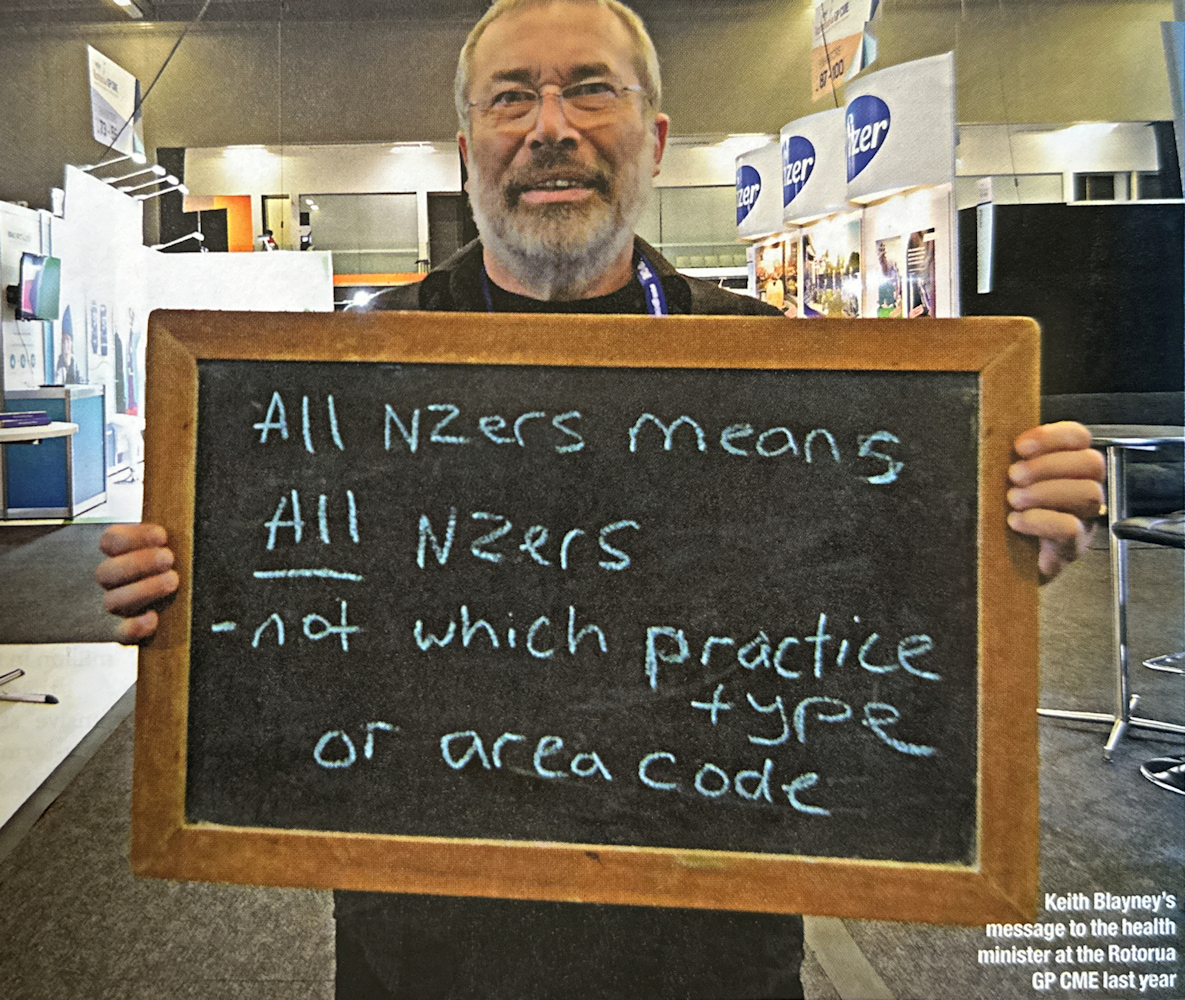
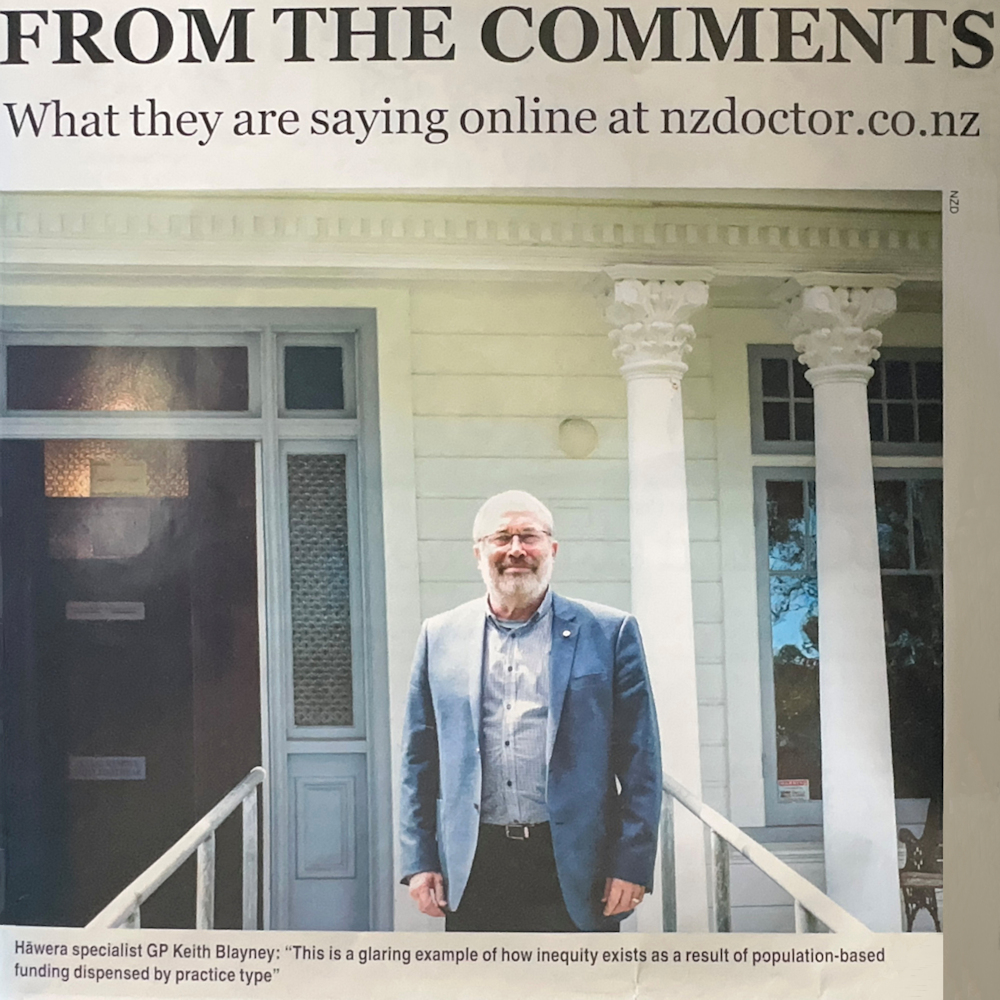
 RNZ NEWS reporter: Ruth Hill "GP earns less than minimum wage after rejecting 'flawed' funding system - Hāwera GP Keith Blayney earns less than his receptionist these days - but claims it is better than relying on the government's "flawed" capitation funding system. RNZ NEWS reporter: Ruth Hill "GP earns less than minimum wage after rejecting 'flawed' funding system - Hāwera GP Keith Blayney earns less than his receptionist these days - but claims it is better than relying on the government's "flawed" capitation funding system.
"Under capitation, practices are paid an annual fee by the government for every enrolled patient - no matter how many times they visit the doctor - and patient fees are capped.
When the system was introduced back in 2001, he and his wife Shirley - the practice manager - decided against joining. He said this was because they could see it was 'doomed to failure', due to the ageing population with ever-growing health needs..."
See the full article on-line at "GP earns less than minimum wage".
Also see why I reject the "Population Based" system "Population-based vs individual-based practise"
To see information specifically about our Practice Fees, go Here
- ⚕ [11 Oct 2024]:
In an eHealthNews.nz opinion piece "What we can learn from the UK's digital dilemma" about a report on the UK NHS (which many want to emulate here), Ray Delany, founder of the NZ CIO Studeo discusses the recent "Independent investigation of the National Health Service in England" by the Professor Lord Darzi Report of Sep 2024 and how that should influence health policy in NZ. In particular, he identifies wasting money on digital technology ("Digital tools cannot compensate for the systemic shortage of GPs, nurses, and specialists" and constant planning (spending on consultants instead of implementing improvements).
Specifically, the Darzi Report revealed lower patient satisfaction, higher waiting times, poorer health outcomes, greater demands for mental health services and increased health disparities. Digital solutions used to supposedly address these issues have been expensive failures. Failure to address the Root Causes is identified as the bottom line. This all sounds very much like the NZ situation.
Delany states - "Blindly adopting overseas models risks repeating costly mistakes". Darzi notes that while a 2006 "White Paper" intended moving care into the community, the proportion of health spending has increasingly been for hospital care. He suggests expanding General Practice, mental health and community services to "lock in the shift of care closer to home by [irreversibly] hardwiring financial flows". This essentially means that primary care funding should go to primary care, to reduce hospital care need, and not be reduced or restricted [as we have in NZ] in order to fund increasing secondary services caused by the reduced primary funding (or spending on wasteful IT systems)!
Full copy: RayDelany.pdf
Link to Lord Darzi Report: Darzi Report 2004
- ⚕ [30 Aug 2023]:
The GenPro (The General Practice Owners Association of Aotearoa New Zealand) practice survey of August 2023 shows:
"Family Doctor Services Under Significant Financial Pressure"
GenPro provided a Media Release of a survey of it's members which shows nearly 90% of practices were concerned about their financial viability and 35% made a loss in the last quarter of the financial year. 66% had to increase fees and another 23% were about to increase them. On average, practices lost two Practice Nurses, 43% having nursing vacancies and 60% having GP vacancies. 54% have had to reduce services and 68% were having to charge for previous free services (like referrals).
GenPro Survey August 2023 also see
Newshub report on Survey.
These are practices in the PHO system receiving approximately 60% income from capitation (as well as Performance funding, Services to Improve Access funding, Zero Fees for <14 funding, Point of Access Care, Care Plus, Palliative care, Health Promotion funding, and support during COVID-19). Our practice receives none of these (only some token Practice Nurse support and the very low GMS subsidy for children and those with a community Services Card). This is all further evidence that our practice is not profitable - I just call it "my expensive hobby".
Please Note: Our basic GP fees have remained static for four years, and we are hoping to hold them at current levels. However, our fees for Practice Nurse services are lower than practices that have high subsidies, so you will see more realistic Practice Nurse fees until the Practice Nurse Subsidy is restored to the original 100% and complex referrals will also now attract a fee as they can take far more time than the actual consultation.
- [2023]:
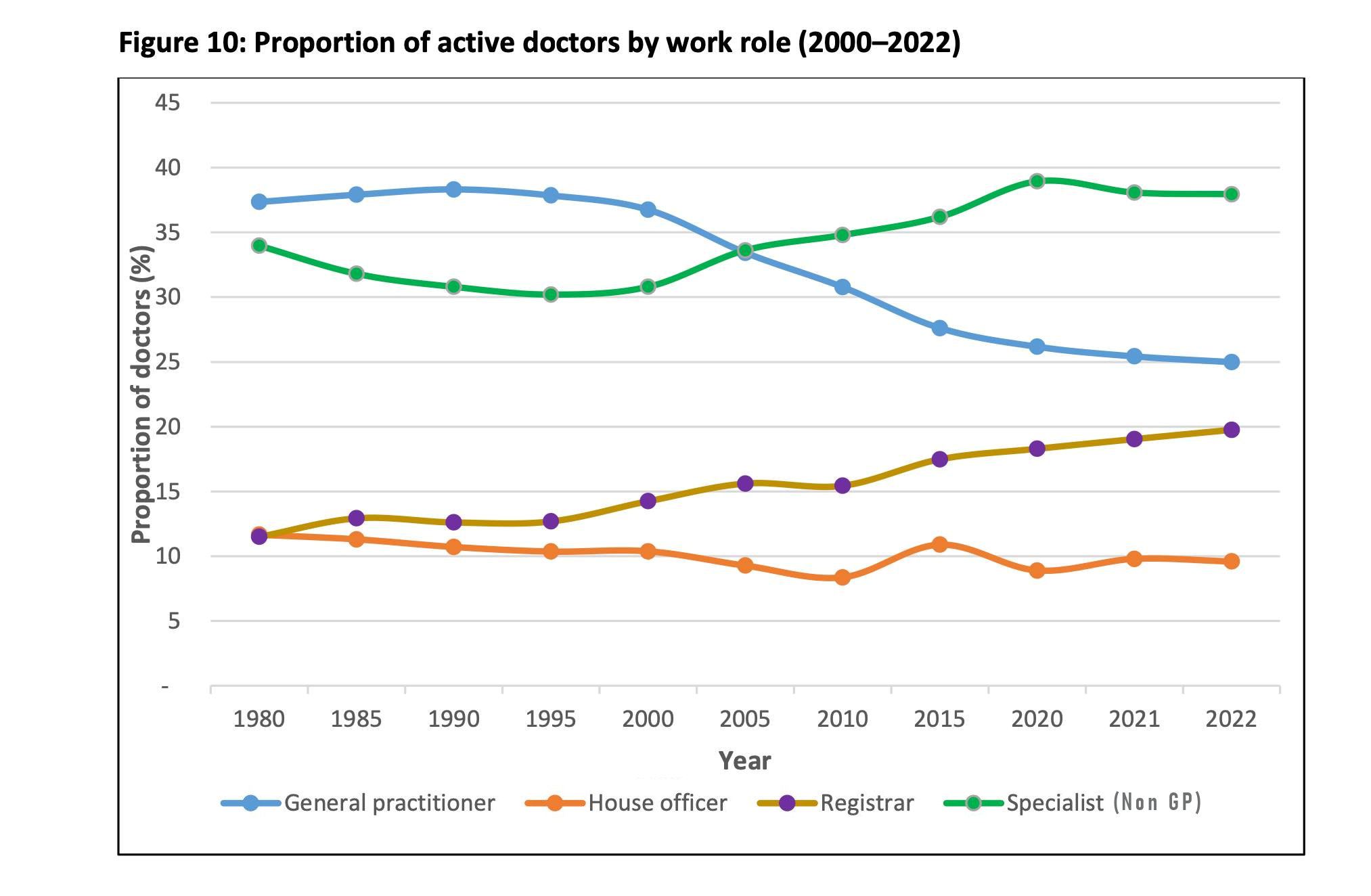
"Graph of "Proportion of active doctors by work role (2000-2022) from the 2022 Medical Council of NZ Workforce_Survey [pg 18] showing a steady deline in the percentage of GPs (including Specialist GPs) of the total doctor number since the introduction of the PHO and Capitation system (37% to 25%). This is another indicator that General Practice has become less attractive (poorer recruitment and retention) as a result. Rather than improving health, making General Practice less attractive is shown in International studies that an increase in health costs occurs as GP prortion falls, reflected well in the New Zealand experience. Click the thumbnail to see the graph.
- ⚕ [4 May 2022]:
The TV3 interview on Rural Health using our practice as an example can be seen here:
Doctors warn people will die if rural communities not prioritised in new health reform.
Thank goodness some of what I said was included, but it is really difficult to talk to a camera and stay focused knowing that all of NZ who watch Newshub will see and hear my unedited comments! I had also talked about valuing Vocational GPs, making rural General Practice attractive again, the danger of fragmentation of care, that funding should actually be for ALL NZers and all types of practices, that the GP Council of the NZMA are our elected representatives and of course how investment in primary care has been shown to hugely reduce downstream use and costs (including ED and secondary care), but the health "reforms" do not seem to address these issues.
Also WTF is a Locality Network (said more politely) other than the same old bureaucrats joined by even more people who do not understand the determinants of health or that programs need to be outcome based?
Really annoyed with Little's comment, as are all my GP colleagues around the country.
Foot Note: Since then the pan-doctor "union" NZMA (New Zealand Medical Association) has ceased to exist for a number of reasons including an inability to represent all doctors. Other groups have now taken over including: the ASMS (Association of Salaried Medical Specialists) [I'm not salaried]; NZWIM (New Zealand Women in Medicine) [I'm not a woman last time I looked]; Te ORA (Te Ohu Rata o Aotearoa) [but I am not Māori]; GPA (General Practitioners Aotearoa) and GenPro (General Practice Owners Association of Aotearoa New Zealand). The latter two are more relevant to us but are more focused on capitation [and we are not capitated].
⚕ [5 July 2022]:
A Sapere* report
"A Future Capitation Funding Approach - Addressing health need and sustainability in general practice funding"
Commissioned by the Health Transition Unit within the Department of Prime Minister and Cabinet has recently been released. It reveals what we have predicted, that:
"The capitation formula for general practice that was developed under The Strategy [the Primary Health Care Strategy implemented 2003] was very limited in its effectiveness" and what all GPs have been saying for some years, that:
"We find that total status quo general practice revenue lies below the likely true cost of delivering care at current levels. This is consistent with widespread anecdotal evidence of constraint in general practice services, with difficulty recruiting and retaining the workforce, and rising barriers for access to care (such as delays in being able to make appointments and practices declining to enrol new patients)."...and for capitated practices it advises:
- "For most practices, the median modelled increase [needed] is between 10% and 20% of current capitation revenue...."
- but for practices with very high needs populations there needs to be "an increase in capitation revenue of between 34% and 231%."
See the full Proactive Release: A Future Capitation Funding Approach report from Sapere.
* Sapere is "a leader in the provision of independent economic, forensic accounting and public policy services." It is management based with no stated expertise in health.
- ⚕ [Nov 2022]: Release of an independent report commissioned by the Labour Government confirming that the Primary Health Care Strategy implemented in 2003 was "very limited in its effectiveness" -see Sapere Report main relevant points.
⚕ [Dec 2021]:
The Pae Ora (Healthy Futures) Bill is before the Pae Ora Legislation Select Committee. This has the ability to change New Zealand's health management for the better by replacing the failed DHB and PHO system with better clinical input and governance but would appear to just rename the jobs and titles of management, add yet more layers of bureaucracy and discriminate health services based on ethnicity not need.
My Pae Ora Submission addresses the inequity in health issue from a needs based approach, better defining the role of a Maori Health Authority and most importantly challenges the lack of focus on high quality primary care (particularly attracting and retaining consultant GPs) as the best way to provide cost effective health care / improvement for ALL New Zealanders (not just some groups).
⚕ [Feb 2021]:
"DHB's 'free care' new entrant feared as threat to Hawera practice viability" article in the 3 Feb 2021 edition of the New Zealand Doctor newspaper. "Hawera independent GP Keith Blayney fears local practices' viability will be at risk".
To see a pdf copy of my response printed in the February article, go to
Wrong footing again.pdf.
⚕ [Jan 2019]:
"Taranaki GP swaps rural funding for personal freedom" article in the Jan 2019 edition of the New Zealand Doctor magazine. "Renegade GP Keith Blayney is switching up his funding model to free himself from DHB meddling and charging all patients at a standard casual rate".
To see a pdf copy of the article, go to
KeithOnNZDoctorJan2019.pdf.
⚕ [13th May 2018]: My submission to the Ministry of Health on the "Mental Health and Addiction Inquiry" where I suggest what we have been doing to date is not working and that we need to apply some Evidence Based action to improving our world leading bad outcomes. There are some excellent New Zealand based prospective data, as well as international evidence for the determinants of mental Health, what isn't working and what we should be doing differently. I have highlighted the need to improve access to mental health services for ALL New Zealanders instead of the current approach of ignoring the most disadvantaged 340,000 plus who are outside the PHO system and that a better approach is needed to address the higher representation of Maori in bad outcome statistics (instead of just documenting it) without ignoring the greater numbers of non-Maori needing help. To see the full submission, go to
Mental_Health_Addiction_Feedback_DrBlayney.pdf.
⚕ [November 2015]: Submission on "Update of the New Zealand Health Strategy" by Dr Keith T Blayney and Practice Manager Mrs Shirley Blayney ,
Our concerns about the New Zealand Health Strategy update were that:
- It doesn't correct the failings of the original Strategy, despite evidence that the Strategy was failing and
- It continues to undervalue GPs who are having further imposition of control and non-evidence based policies and
- It is continuing to further fragment primary care with the loss of the "GP home" for patients
To see the submission, go to
Update of the New Zealand Health Strategy Blayney Submission.pdf.
⚕ [15 April 2015]: "Better Sooner business cases not much better or faster
" as reported in the New Zealand Doctor magazine by Liane Topham-Kindley on the evaluation by researchers Jackie Cumming, Robin Gauld, Kirsten Lovelock and Greg Martin, MidCentral and West Coast DHBs' Better, Sooner, More Convenient business cases. New Zealand Doctor obtained the evaluation reports under the Official Information Act. The report reveals that:
- "Better Sooner More Convenient (BSMC) business cases in West Coast and MidCentral DHBs did not meet their ambitious goals"
- "Many people regarded the plans as too wide in scope and involving too many initiatives at once."
- "Building effective alliance leadership teams tasked with monitoring progress was challenging."
The Report notes that "Working in an environment that was described as one of 'endless change' led to high stress for some staff, disillusionment and cynicism, staff retention issues and an inability to maintain momentum for some initiatives in both regions." A typical General practice response was "The only difference over the years is that we need to provide more PPP [PHO Performance Programme] stats to the PHO; that does not necessarily provide better care for our patients." Of particular concern is that Chronic care (like Care Plus and Services to Improve Access) were supposed to reduce both ED and ASH (Ambulatory Sensitive Hospital) admissions [by 30% and 20% respectively] but "There was no evident consistent downward trend for the population as a whole." This is not surprising as all the changes were management and politically (not clinically) driven and lacked a good evidence base.
The one simple cost effective and evidence based policy that both politicians and health administrators have consistently ignored that would improve primary care and reduce unnecessary or delayed secondary care is to VALUE General Practitioners. If vocational General Practice was attractive to graduates (appropriate status as specialists, better income, better access to investigations, less unreasonable hours), there would be no shortage of NZ trained GPs who could work better for both their individual patients and practice populations. It would significantly reduce health costs, but no, GPs have to be controlled, herded into groups and treated the same as untrained generalists or Nurse Practitioners, so don't expect any improved health any time soon.
To see the full report, go to
oia_bsmc_midcentral_and_west_coast.pdf.
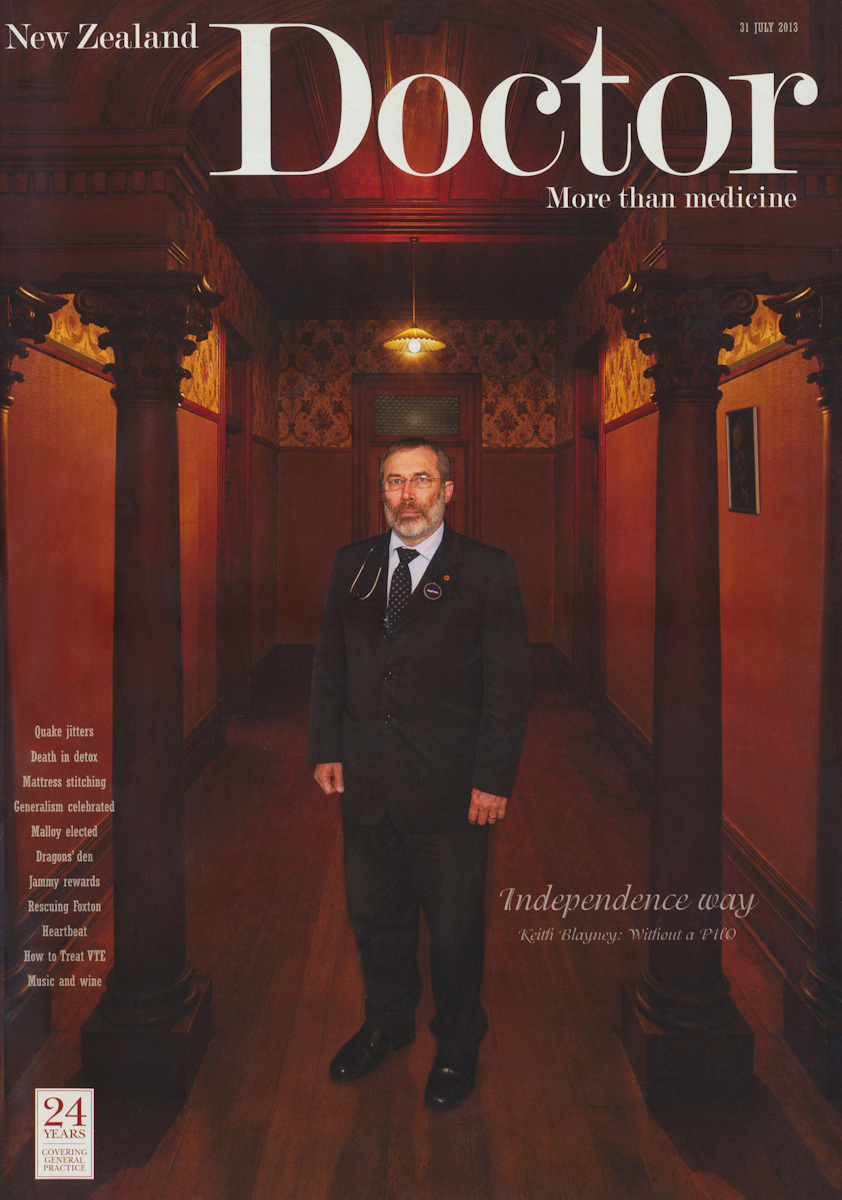
⚕ [July 2013]: "Independence way" is the feature article of the 31 July 2013 edition of the New Zealand Doctor magazine. It is about my remaining independent of PHOs, it is a good summary, but the photo makes me look far more serious than I am! To see the article, go to
Feature NZDoctor 31 July 13.pdf.
⚕ [June 2011]: "South Taranaki -Alive with opportunities for better health care" is the name of the TDHB management review of South Taranaki health services for which I am on the "Steering Group" and so can ensure both a local clinical and public view is both heard and accommodated. In my view, any changes need to be "the same or better" for South Taranaki, cater for ALL (including our patients) and not destroy the hospital. Unfortunately, the Management Consultation Document released fails all thee criteria and so cannot be supported.
I have dedicated a whole page to this issue as it is so important. Here you will find links to relevant documents, how to make submissions, march, protest etc, and my responses, including alternative models. Go to
TDHB ST review page.
⚕ [May 2011]: Finally, proof of the excessive numbers from the TDHB itself when figures on Etthnicity of TDHB employees, listed by employment type also revealed the total numbers! The Table found in the public minutes of the Hospital Advisory Committee of 31st May 2011 reveals a total of 292 in "Administration" and 41 in "Management", a combined total of 333 (half a devil). This is a 12.5% increase in Management & Admin from 2007, despite a Ministerial "cap" on numbers.
Interestingly, the group with the highest proportion refusing to give ethnicity were "Non-Health Support" (20%), closely followed by "Medical" at 17%, while only 4% on "Management" were brave enough to refuse. The minutes are available on the TDHB web site at
www.tdhb.org.nz/dhb/documents/minutes/31-5-11_hac_minutes.pdf] [now removed].
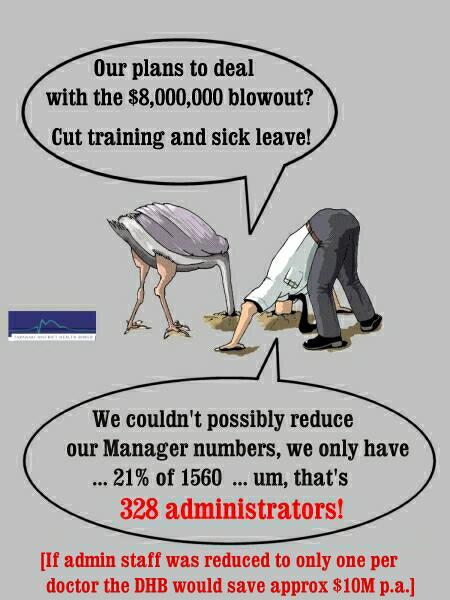
- ⚕ [October 2007]: The government and local health officials repeatedly deny we have too many managers, so how many do we actually have? The TDHB General Manager Human Resources, in a report to the Hospital Advisory Committee [295.1] on 30th May 2006 gave the "Skill Mix at April 2006" for the TDHB as Medical 9%, Nurses 45%, Allied Health 17%, Non-Health Support 8%, Management/Admin 21% (ie over 2.3 admin staff for each employed doctor!) [Ref: www.tdhb.org.nz/board/HAC%20Minutes%2020060530.pdf] [now removed].
• The TDHB Annual Report lists 1560 employees. 21% of 1560 = 328 Managers & Admin staff
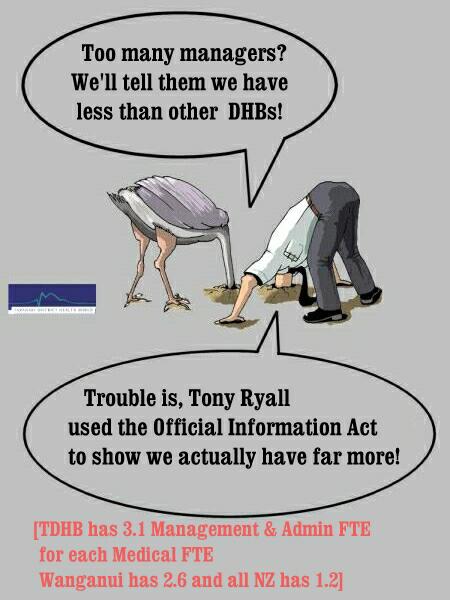
• Tony Ryall (National's health spokesperson) obtained the following figures under the Official Information Act:
| DHB | Management
& Admin FTE | Medical FTE | Admin:Doctor ratio |
| Taranaki | 296 | 94 | 3.1 to 1 |
| Wanganui | 196 | 73 | 2.6 to 1 |
| all DHBs | 9804 | 5683 | 1.2 to 1 |
• The Taranaki Daily News of 3rd Dec 2007 gives a figure of 246 Managers
• I have made a list of all TDHB management positions I could find (excluding P.A.s and clerical staff and excluding PHO management), the list is now 114 actual Managers.
- see Management.doc [34KB] or Management.pdf [86.5KB]
• In the Taranaki District Health Board Annual Report 2017-2018, the number has risen to 359 [43 "Management" and 316 "Administration"].
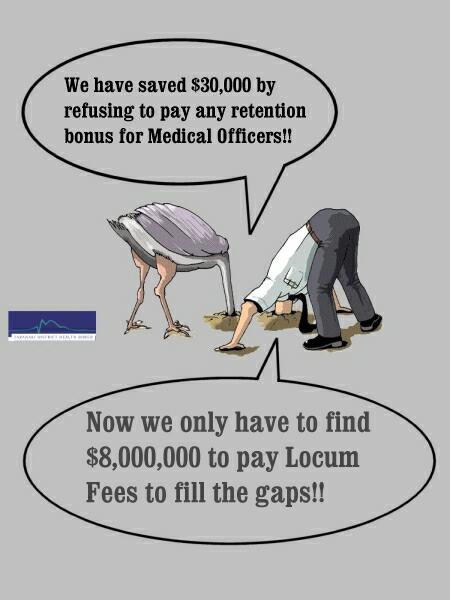
What is most upsetting about these numbers is that one third of the salary of just one of the hundreds of unnecessary managers would pay for all the Medical Officer retention proposals rejected outright by management and we would have much less difficulty recruiting and retaining these doctors!!
- ⚕ [July 2007]: Public Deputation to the Taranaki District Health Board (TDHB) on the
Provision of adequate lower-level Secondary medical services in South Taranaki. The minimum medical staff for a viable in-patient service, including monitored beds, has not been maintained, so a more attractive position is proposed with a request to the Board to support this policy. This Deputation met with a hostile management response inconsistent with the TDHB Mission statement of "Welcoming new ideas".
- see Abstract [17.6KB] or SthTaranakiDeputation.pdf [62.6KB].
- ⚕ [May 2007]: Primary Heath Issues in New Zealand - politicians and bureaucrats are essentially speeding up the exodus of NZ trained doctors while doing nothing to retain and recognise the value of those left. I offer some solutions to current PHO, ethnicity and retention issues.
- see Health2007.doc [56KB] or Health2007.pdf [53KB].
- ⚕ [July 2005]: The Medical Reference Group of the Health Workforce Advisory Committee has got it all wrong and produced a very political document that if implemented will see even fewer NZ trained GPs working in New Zealand - see Medical Workforce in NZ.
- ⚕ [June 2004]: The Primary Health Crisis in South Taranaki paper.
- see PrimaryCrisis.doc [41KB] or PrimaryCrisis.pdf. [42KB]
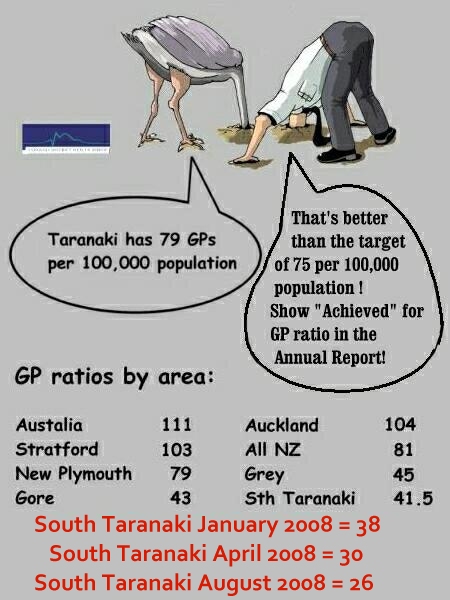
- Because of political and Health Board failure to understand that retention is far more important than recruitment, by mid 2007 the GP:population ratio for South Taranaki had become the lowest in the country at 41.5 GPs per 100,000 population and by March 2008 another three had left giving an incredibly low GP ratio of 30/100,000. All GP workforce policies to date have predictably sped up this loss.
- ⚕ [April 2003]: Rural Primary Health Paper - comment to politicians from a South Taranaki GP
- see RuralGP.
- ⚕ [June 2003, updated Sept 2004]: IPAs & PHOs - a brief note on capitation & control.
- See IPAs & PHOs.
- ⚕ Practice Newsletter Archives
⚕ Political Aspects of the sorry PHO saga
- [June 2004]: The National Primary Medical Care Survey report showing the failure of capitated practices to deliver (compared to non-capitated practices).
- [July 2004]: Minister of Health personal intellectual response to my PHO critique!
- [August 2004]: Letter to Editor South Taranaki STAR, 12/08/04
- [August 2004]: My reply to Annette King about PHOs
Acrobat version [for printing] DearAnnetteKing.pdf [28KB].
- [Nov 2004]:The Hawera GP appeal against the failure of TDHB to recognise us as rural TheChairman.doc [MS Word -30KB] or TheChairman.pdf [Adobe Acrobat -21KB].
- 2009 brings evidence from both the OECD and the Ministerial Review Group "Meeting the Challenge" report [aka the "Horn Report" after the Group Chairman Murray Horn] that PHOs have been a huge waste of money, increased the demand for limited GP services and not achieved any stated goal - except reducing GP fees. Of course, if non-PHO GPs had similar patient subsidies, they would have extremely low fees as they don't have to support the additional bureaucracy.
[April 2009]: "The PHOs should either be eliminated as an unnecessary new bureaucratic layer or else their role and obligations must be more clearly defined" see
OECD Economic Survey of New Zealand (2009) [Adobe Acrobat -322KB]. and
[31 July 2009]: "While we accept the logic of the OECD recommendation above we consider that PHOs should first be given the opportunity and encouragement to help develop new models of care.....Unless PHOs can do significantly more in the direction suggested above, questions need to be asked about the extent to which they are playing the role that they should be.....DHBs should not be restricted to dealing with PHOs if direct agreements with others, like NGOs [and other providers like private non-PHO GPs], can achieve the same ends.....Left unchanged, the current DHB- and PHO-based model of health delivery is likely to rapidly generate an unsustainable tension between the community's expectations of the public health service and the community's ability to finance those expectations." see
MRG Report "Meeting the Challenge" [Adobe Acrobat -250KB].
- 2022 Independent Sapere Report (see See above) confirming that the Primary Health Care Strategy implemented in 2003 was "very limited in its effectiveness"
- 2023 Medical Council of NZ Workforce Survey (see See above) showing a steady deline in the
percentage of GPs (including Specialist GPs) of the total doctor number since the introduction of the PHO and Capitation system (37% to 25%).
I am happy to receive any feedback on any of these topics (see e-mail options on the right).
Dr Keith Blayney
|
|
|